Nobody Nerfed the Model. My System Drifted.

There’s a specific kind of pride that comes from building the thing that makes a tool yours. For the better part of a year, that’s what I had.
I’d built an expert system around Claude - a layer of my own design sitting between me and the raw model. Per-domain experts, each with its own isolated context and operational memory: one that knew my WordPress hosts and their SSH quirks, one that knew my server topology, one that knew how I run mobile builds. A memory layer with structured frontmatter so findings survived past the session that produced them. Hooks that, the moment I dropped into a directory, walked the filesystem, read the project’s declared dependencies, and composed the right experts into context before I’d typed a word. Drop into a WordPress project and the WordPress expert was already there, already holding everything I’d taught it.
It worked. It genuinely worked. It made me faster, and more than that, it made the assistant feel like an extension of how I think about my own infrastructure. I was proud of it the way you’re proud of a workshop you built yourself - every jig in its place, every tool where your hand expects it.
And then, slowly, it started getting worse.
Not dramatically. Just friction where there hadn’t been friction. The model second-guessing things my system had told it. Conflicting instructions producing hedged, worse answers. The composition that used to feel like leverage starting to feel like noise.
Here’s the part I want to be honest about, because it’s the easy story to get wrong. The reflex - everyone’s reflex - is to go online and post that the model got nerfed. That some quantization or cost-cutting quietly made it dumber. It’s a satisfying story because it makes you the victim of someone else’s decision. Sometimes it’s even true.
But mostly it isn’t. Mostly what you’re feeling is context drift.
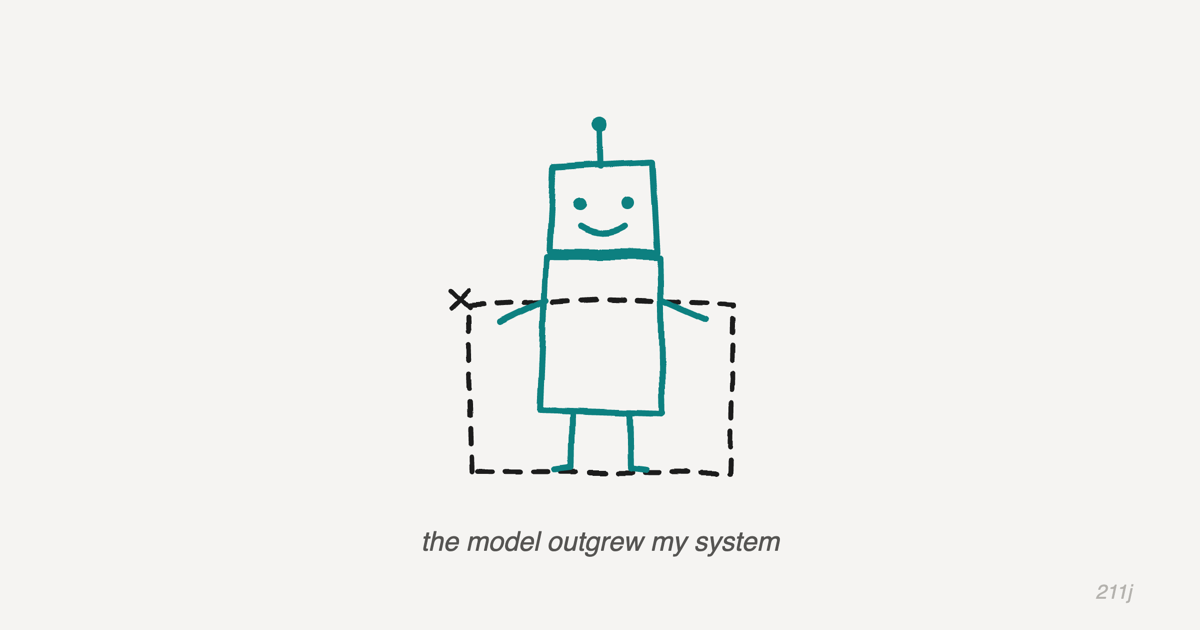
My system was a snapshot. I’d built every piece of it to compensate for something the model couldn’t do yet at the moment I wrote it - to scaffold around a gap. But the model didn’t hold still. It kept getting better. And every improvement quietly turned a piece of my scaffolding from load-bearing into redundant - and then from redundant into actively in the way. The instructions I’d written to make the model behave were now arguing with a model that already behaved that way on its own, and better. I wasn’t experiencing a worse model. I was experiencing my own year-old assumptions, frozen in amber, fighting a moving target.
There’s an idea that had been circulating in the AI-engineering community, in a line that stuck with me: instructions are technical debt. Every rule you write is a liability you’re now obligated to maintain against a system that won’t stop changing underneath it.
So instead of writing the angry post, I did the thing the situation actually called for. I had Claude analyze the overlap - map my custom system against what the harness now does natively. Which of my experts were just reimplementing subagents the platform now ships. Which of my hooks duplicated native events. Which of my memory machinery the auto-memory had quietly made obsolete. Which of my carefully-tuned instructions were now just contradicting defaults that had grown past them.
The answer was brutal and clarifying: most of it. The overlap was enormous. A large fraction of the thing I was proudest of had become dead weight that was degrading the very performance it was built to improve.
So I deleted it. Most of it. Kept the maybe fifteen percent that covered things the platform genuinely still doesn’t - my actual credentials, my actual host topology, the handful of conventions that are mine and no one else’s. The rest went.
I want to name why that was hard, because I don’t think it’s obvious. Deleting working code that you built and understand and are proud of is one of the most uncomfortable moves in engineering. Every instinct says protect it - you earned it, it represents real hours, it still technically runs. But the highest-leverage judgment in this whole field isn’t building the system. It’s recognizing the moment your own system has become the problem it was built to solve. The fix, left in place too long, becomes the cause.
That’s the move I’m proud of now. Not the system. The deletion.
The model didn’t get nerfed. I’d just stopped noticing that the ground had moved - and the engineering wasn’t in the scaffolding I’d built around the gap. It was in being willing to tear it down once the gap had closed.